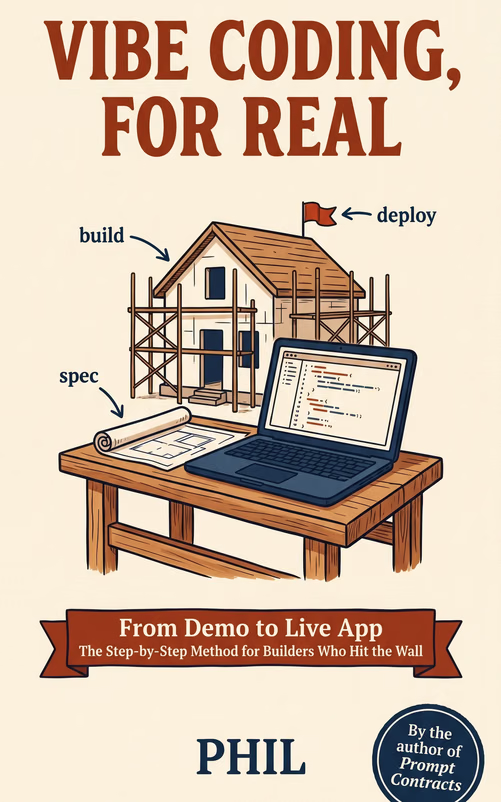
Vibe Coding, For Real
From Demo to Live App, the Step-by-Step Method for Builders Who Hit the Wall
You opened Cursor. You typed "build me an app." Something appeared. It looked real. You tried to add login — and the whole thing fell apart. This book is the bridge between a demo and a shippable product.
Free with Kindle Unlimited
Or buy it: Kindle $9.99 · Paperback $19.99
Vibe Coding, For Real teaches the Blueprint Method — a repeatable 8-step process you apply twelve times across the book, on the same project, until it becomes muscle memory. You don't write a single line of code. The AI writes everything. Your job is to specify, push back, and verify. By the end, you'll have shipped a real CRM for independent artisans: clients, job sites, quotes with PDF export, multi-user authentication, dashboard, payments, deployed live. Same stack as a real production SaaS — Next.js, Supabase, Stripe, Vercel.
What you ship by the end of the book
A working CRM · multi-tenant auth · PDF quotes · Stripe payments · live in production
Who this book is for
The Blueprint Method
8 steps, applied 12 times, until it becomes muscle memory
Broad description of the feature, in plain words. No tech jargon yet.
Ask the AI what this implies technically — database, routes, security.
Fields, validation, edge cases, error states — written in the spec, not discovered in prod.
Hand the spec to the AI. Code appears.
Ask the AI to explain what it built and why. You learn while it talks.
Happy path, edge cases, and "what could go wrong" — before a user finds out.
Topic-specific traps the AI walks straight into if you don't stop it.
Re-run the earlier chapters' features. Nothing silently broke.
13 chapters, one shipped app, zero filler
The stack you'll learn to ship on
Real production tools, not toy environments. The same stack as a paid SaaS.
"A demo is a deck. A real app is a house. Same wood, completely different process."
About the author
Phil writes on Medium under @rentierdigital. 20 years in software, from French banks to a shrimp fishery in Madagascar. Now a solo developer shipping SaaS products with AI from wherever the Wi-Fi holds.
Stack: Next.js, Convex, Clerk, Vercel, n8n. Self-hosted AI agents. Everything in this book has been deployed, broken in production, fixed, and deployed again — twice over.
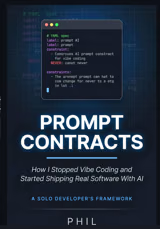
Stop collecting tutorials. Build something real.
Get Vibe Coding, For Real on AmazonFree with Kindle Unlimited
Or buy it: Kindle $9.99 · Paperback $19.99
Frequently asked questions
Do I need to know how to code?
No. You don't write a single line of code in this book. The AI writes everything. Your job is to specify clearly, push back when the AI suggests something stupid, and verify that what it built actually works. That is the entire skill the book teaches.
How is this different from Prompt Contracts?
Vibe Coding, For Real is the on-ramp — one project, walked end to end, designed for someone who has never used Git, Supabase, or Vercel. Prompt Contracts is the advanced framework, written for developers who already ship and want production-grade specs. Start here if you're new, read Prompt Contracts after.
Which AI tools does the method work with?
The examples use Claude Code. Cursor and Codex CLI work just as well. The Blueprint Method is tool-agnostic: it teaches what to say, in what order, and how to verify — the underlying AI can change.
Is there a companion repo?
Yes — the full CRM is open source. Every prompt published in the book produced the code that runs there, and every code path is e2e tested. If you get stuck on a chapter, the repo is your reference implementation.