How to Learn Anything in a Weekend With Claude and Codex (And Actually Remember It)
Let AI organise your sources, then make it test you. These 6 steps turn a smooth read into something you can use.
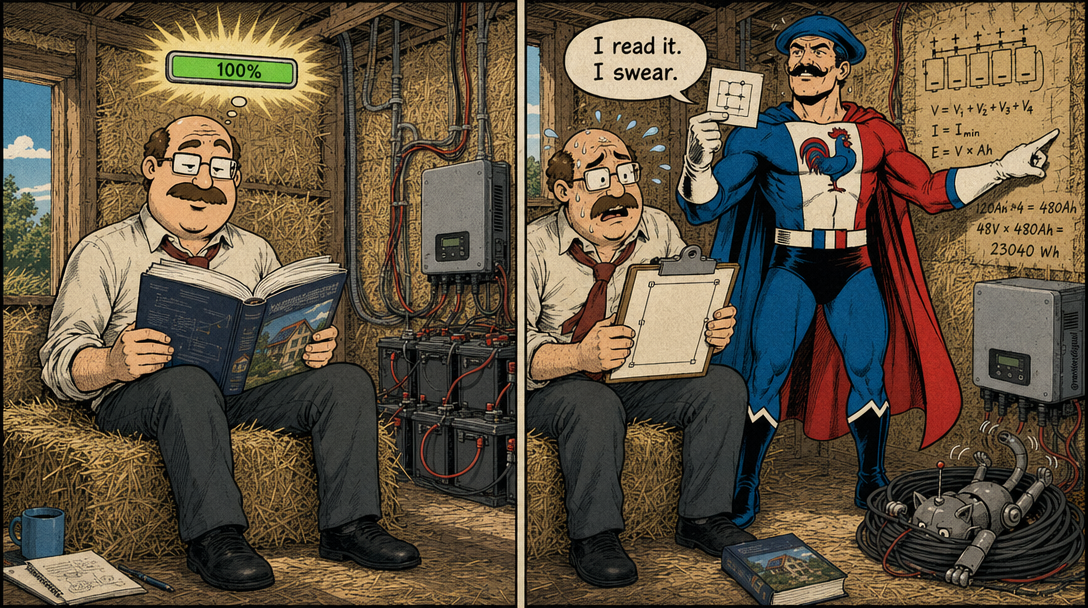
Let AI organise your sources, then make it test you. These 6 steps turn a smooth read into something you can use.
I read a 140-page book about off-grid solar in 2 evenings, then couldn't reproduce the battery calculation 3 weeks later.
Claude had written the book for me.
I had read it.
I didn't know it.
I was building a straw-and-earth house and needed to understand its autonomous electrical system.
The book drew on 8 sources, including purchased solar ebooks, inverter and battery documentation, installer transcripts, and accounts from other self-builders.
It brought together battery placement, ventilation, cable routes through straw walls and fire risk.
Then I needed to reserve the technical room and size the battery bank, and the reasoning wasn't there without the book open.
Apparently, my brain had accepted the loading screen as the game.
The fix was to change the job I gave the AI.
Claude could still organise the material, but I had to predict, calculate, retrieve and explain.
You can run that division of labour with Claude or Codex.
The solar story happened with Claude, and the method below is something you can apply with either tool.
A perfect explanation can hide an empty save file.
Easy Reading Can Hide Missing Practice
The attractive version goes like this: collect 7 to 10 reference books and some video transcripts, then ask an AI to turn the lot into a readable book you can finish in 2 evenings.
The chapters arrive in a sensible order.
Repetition disappears.
The connections have already been made for you.
That is useful for exploring a subject and deciding what to study.
It also makes recognition feel suspiciously like competence.
While the explanation is visible, every step seems obvious.
Close it and ask yourself why the author chose that assumption, and the progress bar becomes less convincing.
In Roediger and Karpicke's study, students who studied a passage once and took 3 recall tests remembered about 61% after a week.
Those who studied it 4 times remembered about 40%, despite expecting to remember more.
Repeated study performed better after just 5 minutes.
These were short passages, so the percentages don't predict your results with an entire book.
The lesson is that immediate fluency and later recall can point in different directions.
The same distinction matters when an AI helps.
In Bastani and colleagues' mathematics experiment, an unrestricted GPT-4 tutor improved practice performance by 48%, but the later exam without AI was 17% below the control group.
A tutor that guided students without handing over solutions largely mitigated that harm.
The model's role changed the outcome.
So I let the AI handle the preparation and feedback.
I keep the attempts.
Saturday exposes gaps and organises the sources.
Sunday makes me produce answers, with short recall sessions after the weekend.
Pick a bounded task you can practise in that time, rather than an entire discipline.
Start Saturday by Getting Something Wrong
Step 1 asks you to attempt a pre-test.
Before reading the explanations, answer around 15 questions about what you want to learn.
“Understand off-grid solar” is too broad.
“Explain the assumptions behind a battery-capacity estimate” gives you a task you can assess.
Ask Claude or Codex to present a question, wait for your answer and only then provide a correction linked to a source.
Keep its answer key out of the message containing the question.
Otherwise, you've built a quiz with subtitles for your own thoughts.
Write an answer even when you expect it to be wrong.
Record your confidence before reading the correction.
An uncertain guess and a confidently wrong explanation need different attention later.
Research by Kornell, Hays and Bjork found that failed retrieval attempts can help subsequent learning when the correct information follows.
The mistake creates an opening for correction.
Leaving it uncorrected just gives the mistake somewhere to live.
This stage can feel like arriving at the boss fight before the tutorial.
You aren't trying to pass it yet.
You're finding out which parts of the tutorial you actually need.
The answer you couldn't produce tells you more than the paragraph you enjoyed.
Keep Each Author Attached to Their Claims
Step 2 extracts each source separately.
Get a short note for each book, document or transcript before asking for a combined explanation.
Keep the author, source location, claim, assumptions and limitations together.
If an author recommends a particular battery setup, the conditions behind that recommendation belong in the note.
A different climate, chemistry or load can change what the advice means.
A confident sentence with its assumptions removed is a poor foundation for a decision.
Check the important claims against the original material.
The AI should identify unavailable pages or unreadable diagrams and admit when it cannot locate a passage.
An invented page number is still invented, even when it wears a citation costume.
Step 3 maps the disagreements.
Ask where the source notes conflict, then check whether the authors are discussing the same conditions.
Different assumptions can explain an apparent contradiction.
Sometimes the disagreement is real and needs to remain visible.
My second book project, about education and children's autonomy, made that problem concrete.
Some sources argued that rewards can undermine intrinsic motivation.
Others supported positive reinforcement and point systems.
A punchy synthesis could flatten that into a single recommendation and hide the decision I still needed to make.
The map asks what each author means by a reward, which behaviour they discuss and what outcome they care about.
It preserves the argument long enough for me to think about it.
If your AI erases the disagreement, it also erases the decision you needed to practise.
This is also why I wouldn't judge the process by how quickly it produces a summary.
Melumad and Yun's research found shallower learning from LLM summaries than from gathering information through web links in their study tasks.
A ready-made synthesis can remove some of the work of assembling an understanding.
My source notes and disagreement map are meant to put that work back into the conversation.
If you want to use what you read without starting again each time, the kit gives you a weekend method to follow with Claude or Codex.
Work through the example first, then apply the same sequence to one small goal from your own project.
Keep your attempts, check the gaps and return to the questions after the weekend.

Get the method and put your learning to use.
By Saturday evening, you should be able to point to your sources and name what remains uncertain.
Sunday checks whether you can do anything with them when they're closed.
Make Sunday Leave Gaps You Must Fill
Step 4 turns explanations into attempts.
Ask for a short chapter that leaves out a key calculation, prediction or conclusion.
Complete the missing reasoning before revealing the worked answer.
The gap needs to require a decision, rather than guessing an adjective the AI deleted.
Here is an invented example from the kit, using a fictional workshop policy.
A room is available for 180 minutes.
Each ordinary session lasts 45 minutes and requires 15 minutes of cleanup inside that booking window, including after the final session.
How many complete sessions fit?
Try it before reading the next paragraph.
Each session uses 60 minutes of the window, so 3 fit.
Dividing 180 by 45 gives 4 because it silently removes the cleanup requirement.
The useful part of the feedback is identifying that missing constraint, not merely displaying the number 3.
Now change the session length or the cleanup rule and try again.
That checks whether you understood the reasoning or memorised the previous answer.
The full kit keeps the exercise and answer files separate so you can make an honest attempt first.
This uses the generation effect, the advantage often found when people produce material instead of only reading it.
Bertsch and colleagues' review covered 86 studies and found an average advantage of about 0.40 standard deviations.
That isn't a promise of 40% better recall.
It supports making room for your own production.
For a complete beginner, start with a worked example and remove a small step from the next one.
Research on complex learning materials shows why difficulty can become counterproductive when the prerequisites are missing.
You don't learn a game's controls faster by unplugging the controller.
Step 5 brings the questions back later.
Close the chapter and answer from memory, then revisit the ideas the next day, a few days later and the following week.
Use those intervals as a starting schedule and adjust to what you miss.
Record whether each answer was independent or needed a hint.
Put the reviews in your calendar and keep the attempt log outside the chat.
A model saying “see you next week” hasn't created a reminder.
It has written dialogue for a calendar event that doesn't exist.
Reading the answer trains recognition. Producing it gives recall a job.
Step 6 makes you teach the subject back.
Explain it without your notes and ask the AI to compare your reasoning with the checked sources and disagreement map.
It should challenge assumptions and ask a follow-up where the explanation gets vague.
Finish with a changed example, so repeating yesterday's wording won't be enough.
When I rebuilt the solar material around this process, I could reconstruct the battery-sizing reasoning and explain the room-placement decisions without reopening the book.
That is my qualitative experience, not a controlled retention test or a substitute for checking electrical designs against authoritative requirements.
The practical change was that I could supply the reasoning myself.
Both Tools Must Wait for You
Use Claude with the source material available to the conversation.
With Codex, you can keep a study folder containing the sources, checked notes, questions and attempt log.
OpenAI's documentation illustrates keeping task context in files, which makes that organisation a practical option.
It does not establish that Codex is a validated learning tutor.
For either tool, start with readable text and ask it to list what it actually accessed.
Keep scanned pages and diagrams out of the assessed material until you've checked their extraction.
Give the learner only the question file during an attempt, and reveal the worked answer afterwards.
Codex's ability to finish work for you makes the instruction especially important: during a learning exercise, it must stop and wait for your attempt.
It should not solve the task, fill your worksheet and award you a gold star for supervising.
The kit uses the same 6-step sequence with a setup block for each tool.
You can use either one throughout.
Switching between them is optional, and both can make mistakes.
Check consequential corrections against the sources rather than accepting agreement between 2 models as proof.
Choose Sources You Can Legitimately Use
Use your own notes, permitted excerpts, open material and documentation you are entitled to process.
Purchasing an ebook doesn't automatically grant every right to upload or redistribute its full text.
A public video isn't automatically public-domain material either.
The Anthropic copyright settlement concerns a $1.5 billion fund over pirated books, with final approval granted on July 20, 2026.
That litigation isn't a ruling on your personal study folder, but it makes file provenance difficult to dismiss as a technicality.
The kit contains original templates and a fictional practice corpus, not copies of the books behind this article.
The Weekend Still Costs You Effort
The version that helped me took 2 days of attempts and feedback instead of 2 evenings of smooth reading.
It included wrong answers, slower chapters and another 10 minutes booked for recall the following week, with more practice wherever gaps remained.
The studies support the building blocks, not a guarantee that this exact kit will make any subject stick.
If your reading makes sense on screen but disappears when you need it, give yourself a different kind of weekend.
Use the method to practise one thing you want to explain or do, then check what you can produce without your notes.
Start practising what you want to remember.
My first solar book could explain the battery calculation whenever I opened it.
After the second pass, I could explain it too.
That's what I wanted the weekend to buy.
Sources
- Roediger and Karpicke studied testing and delayed recall.
- Bastani and colleagues tested AI tutors with different guardrails.
- Kornell and colleagues examined unsuccessful retrieval attempts.
- Melumad and Yun examined learning from LLM summaries.
- Bertsch and colleagues reviewed the generation effect.
- Research examines difficulty when learning complex material.
- OpenAI describes using files to preserve task context.
- The settlement administrator reports the Anthropic case's status.
The linked study kit is my own paid product.
The article lays out a 6-step method to learn and retain material with Claude, but smooth reading can hide empty understanding. The kit's demo-vs-product checklist helps spot the gap between feeling competent and being ready to ship.
This post may contain affiliate links. If you click them, I might earn a small commission at no extra cost to you. It helps me keep publishing articles.